Click for FREE newsletter & bonuses!
Music and Emotions.... How Some Singers Can Let It All Go Onstage.

Music and Emotions...
A Note from Barbara (2026):
I first wrote this article on Music and Emotions in 2010. I still believe that emotional openness lies at the heart of meaningful singing. Today, however, I would add that emotional expression is not always big and dramatic. As we grow older, expression can become quieter, deeper, and more truthful.
So I have changed the tone of the language a little bit in this long-ago posted article to reflect my current ideas. I hope you find them helpful! (Also see my Youtube Channel - Singing After 40 - for more current videos on singing when you are over 40/50/60/70! :)

-----
Some singers have a natural ability to emote through their voices. As a teacher for many years, and as a professional singer, I've often been surprised by those singers who seemed very shy and quiet in their daily lives, who could then walk onstage and have huge emotional impact.
What kind of impact am I talking about?
Have a look at these well-known singers during some high emotional moments and then we'll talk more about the idea of being "open to the creative moment" onstage. !Emotional Abandon!
A Very Specific Talent for "Letting Go"
I am not presenting these singers to you as pop music's 10 best female singers, as the video header reads. That is the opinion of the person who compiled the video clips. (You and I could do the same thing with singers from almost any genre.)
And to be honest, I don't like some of the "shouting" that we hear in some of these clips. But I am looking at a very specific ability - that of being able to "let go" in a performance - to be free enough emotionally (and vocally) to fall "into the flow" of creation in front of an audience.

Music and Emotions - Csikszentmihalyi
What does it take to get into the flow? One writer/researcher, Dr. Mihaly Csikszentmihalyi, whose studies covered many disciplines (not just music), says this:
"I spoke with chess players, rock climbers, musicians.. asking them to describe their experience... I really expected quite different stories to emerge. But the interviews seemed in many important ways to focus on the same quality of the experience.
For instance, the fact that you were completely immersed in what you were doing, that the concentration was very high, that you knew what you had to do moment by moment, that you had very quick and precise feedback as to how well you were doing, and that you felt that your abilities were stretched but not overwhelmed by the opportunities for action.
In other words, the challenges were in balance with the skills. And when those conditions were present, you began to forget all the things that bothered you in everyday life..."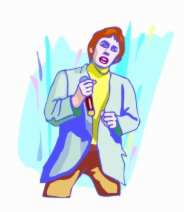
Open up. Yet Dig Deep.
Csikszentmihalyi sums up his findings... "In a sense, flow is what drives this human need for going beyond what we have.... it is always a struggle, and the struggle has to do with essentially opening yourself up and yet delving deeply into yourself."
WHAT ARE SOME OF THE QUALITIES OF FLOW?
In talking about flow - we are also looking at specific qualities of music and emotions...
- a desire to express one's feelings
- the willingness to take chances in rehearsals and onstage
- vocal technique that suits one's style of music
- music that allows a singer to be fully emotional
- a lot of practice
- knowing that this kind of emotional release is very good for us as human beings. We don't have to be performers to benefit from learning how to express our emotions better.
And in terms of being onstage... there are many more mysterious elements that allow for highly-engaged performances.
Think about these things the next time you sing or perform!
I Wish You Great and "Flow-full" Singing!

Return from Music and Emotions to Singing Tips with Barbara Lewis


